Looking Without Seeing
Identity and perception inside an artist’s work.
I want to get into his brain immediately.
Instead, I’m circling it — inside the Guggenheim Museum is Rashid Johnson’s love letter to deep thinkers.
The artist plays with language, material, and form to question what we believe — and whether we can ever step outside the forces that shape us.
As Rashid says — we are a product of our time.
I would add: and of our family.
He’s the perfect example — shaped by the world but also the crushed idealisms of his parents, who challenged hierarchies and strived to establish new orders.
His work carries that weight. He represents people who resisted. Who didn’t walk straight into the tornado that pulls and doesn’t let go.
They escaped it.
But that escape built something else.
A world that still isn’t fair.
Capitalism. Political systems in which power sits in the wrong hands.
And now — we’re inside it.
Part of it.
He turns the lens both ways. Outward. Inward. No ego. Just exposure.
We try to belong. To get accepted. But we lose parts of ourselves in the process.
In one self-portrait, Rashid looks like he’s somewhere else far ahead, into a world of possibilities and change we haven’t begun to see. In another, his hair is parted, mimicking whiteness to the extreme — showing the absurdity of assimilation, exaggerating the version Black people are forced to adopt to belong.
His piece Stay Black and Die, hits.
Not a canvas. Cheap felt, sprayed brown.
It’s a warning. If you live in someone else’s skin, you disappear in it. If you conform, you don’t survive — you dissolve.
Fire Pit: High Life shifts the tone. Its surface seduces. Its shape hints at movement. Possibility. It looks like a boat. But it’s not a vehicle.
It’s a container. Where something burns.
The high life isn’t freedom. It burns you mentally first, then physically. The high life is the issue. The way people behave rich, indulging in material desires without caring about others.
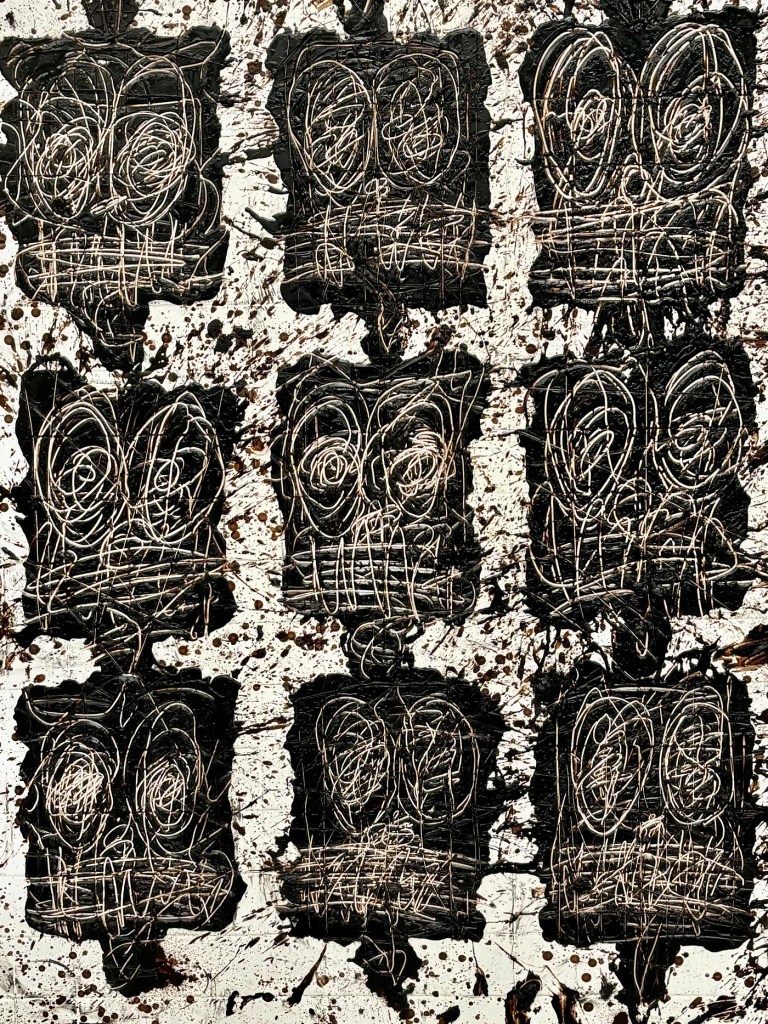
Untitled Anxious Audience brings different questions. Black faces pulled into cube-like forms. Almost robotic. Distorted. Waiting — for judgment.
Triple Consciousness makes that tension visible. One reflection becomes many — a fractured but interconnected reality. Not separate, but layered.
Blackness isn’t one thing. It holds multiple truths at once.
And beyond that—so do we. We all carry different versions of ourselves. Realities shaped by experience, memory, expectation. They don’t always align— and maybe they’re not supposed to.
So don’t flatten them. Don’t shrink yourself to fit a single narrative. Look beyond the surface — beyond the reflection. Find what is yours. And wear it without shame.
In another piece, books are piled together and protected. They communicate something essential. Words that express our present reality should be protected like paintings. They matter.
And still — most museum visitors walk past without stopping. Without reading. Some spend ten seconds tops. A glance. A photo. Gone.
How do we make people pause? How do we make them feel something? How do we make them look inward instead of just looking?
If someone stands in front of an artwork for a long time, others start paying attention too. The same herd instinct applies. We copy each other. If everyone treats the museum as something to do on a Sunday while gossiping, it shapes everyone else’s behavior too.
Engagement requires proximity. What if getting closer unlocked something?Right now, the lines on museum floors keep us away. Create distance. They teach us to step away. And most of the time — we obey.
What if we didn’t? And what if seeing art required intention? Not exclusivity — but presence.
Should we ask museum visitors to pass a test before entering? To make seeing an artwork feel rare again?
Work like this isn’t decoration. It’s confrontation.
Rashid Johnson isn’t producing objects for attention or money. He’s showing a reality most people are still avoiding. Exposing what many are too in denial— or too afraid — to face.
His creations are too large to fit neatly into collectors’ apartments. They don’t serve ego. They demand space. Public space.
Where people can stand in front of them — and decide whether to really look.
It’s all there.
Most people just don’t stay long enough to see it.
