The MET Gala For The Masses
When divas and saxophonists take their turn.
I’m perched on the top steps of the MET in New York, tucked near the grand façade so I can see everything and everyone without being on display. I don’t want to be apparent; I want to be transparent.
The first act is a young woman with a chic square haircut in a neatly belted trench coat. She’s got a guy with her — either a boyfriend or a camera-holding lackey. She does the slow-motion “princess walk” down the steps while he films. And then watches the playback, making a face. Not good enough. She does the walk again: eleven times. Each attempt is more forced, the tension in her eyes growing. Is she disappointed in her own pose, or is the cameraman incompetent?
What a trend everyone’s fallen into. People chasing that perfect clip, the perfect lie to post online. It’s empty attention, where “likes” mask envy or indifference. Social media’s making people act like idiots, all for the sake of strangers’ validation. Someone should press the big red button to destroy it.
Two girls, who sound about twenty, sit down on the steps next to me. I don’t look at them; I want to try and guess what they look like just by listening to their voices and their words.
One has a keen, excitable voice. She chatters, “I just said, ‘Wow, you look rich!’ And there were actually rich people right there — so embarrassing! Ugh, I hate rich people. At my job, they’re all done up with plastic surgery… They hate me.” She pauses. Her friend doesn’t respond. “Have you had any work done?”
The quieter, “cooler” voice finally replies: “No, but everyone has…”
That means yes.
The chatty one keeps jumping topics: “I love taking photos! Don’t you?!..’ The other stays silent. “I hate the McDonald’s bathrooms, you can hear everything in the stalls!”
This time, the other just says, “I’m fine with stalls.”
She’s above it all.
The keen one tries to mimic: “Yeah, me too… It’s not that important.”
When they finally stand and go take pictures, I glance over. The cool, barely responsive girl is a bit chubby, draped in a bright pink-and-black jumpsuit with tiny 80s sunglasses. The chatty friend is tall, flat, and androgynous, in loose black pants and a blazer, looking like her assistant.
The 80s queen commands an impromptu photo shoot. She poses on top of the steps — one leg bent, one leg straight, working all the angles. Her friend becomes the diligent photographer/assistant. After each shot, the cool diva inspects the result, then gives a nod that it’s time to move on.
She’s got the power, baby.
A teenage boy with an awkwardly long ponytail appears, clinging to his mother like he hasn’t outgrown that stage of unfiltered neediness.
I snap a quick picture.
An older woman across the steps shoots me a dirty look — maybe she has a similar son. It’s cruel, I know, but there’s a part of me that’s always searching for comedic material. I’m just a mirror, I want to say. Blame the reflection, not the reflector.
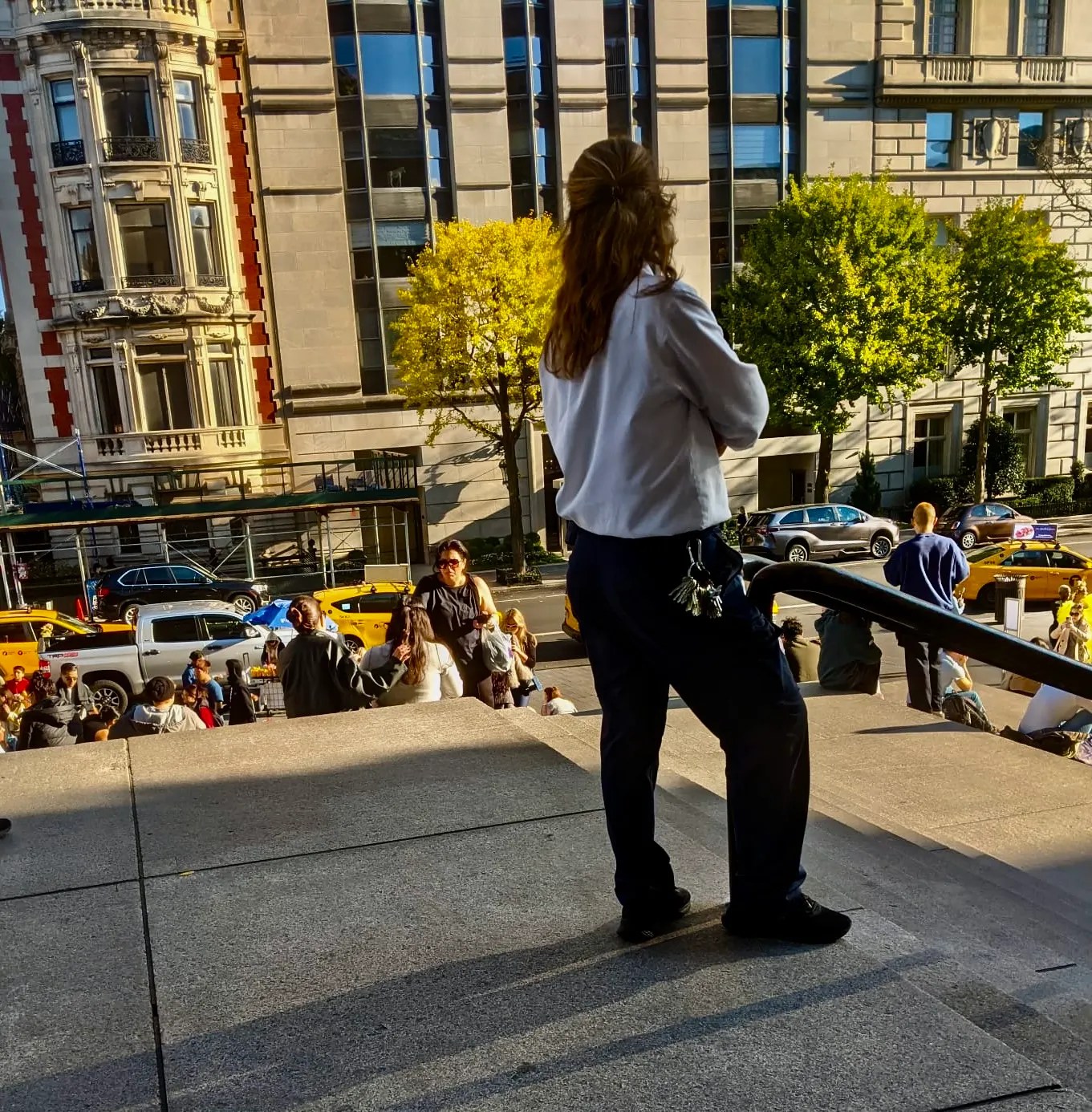
A female security officer with about a thousand keys on one hip, shows up on the steps, standing with one foot pointing upward. She’s got a stern look on her face that says she’s ready to bust your ass. She glances at me like I’m not there, so focused on her task that nothing else matters: looking tough, scanning the perimeter for potential issues — even though there are CCTV cameras everywhere.
Maybe I’m in trouble; I’ve taken a lot of pictures. I move around too much, like an agile bee — and I sting like one too — with my words when I observe. I wonder if I could be mistaken for a spy, just because I write so much, stay in public places longer than the average tourist and take pictures of people’s little dramas. Those who catch me snapping a picture of their photo shoot, glare. They assume I’m mocking them. Maybe I am, a little. But mostly I’m documenting. Highlighting these absurd, random, and sometimes oddly beautiful moments in the city.
Maybe I should sit on the other side of the MET steps so people can also check me out. I welcome anyone to write about me while I write about them. I’m curious to read how a perfect stranger might describe me.
I drift to a tarot reader set up by the steps. Her client is a teenage boy with too many pimples. The tarot reader performs her usual shtick.
“That’s a great card!” she exclaims with every reveal. If something negative appears, she quickly spins it into “But don’t worry, because Saturn is in retrograde…”
I wonder if this kid is bullied at school, hoping the universe will magically fix it. The psychic tries to convince him his luck is turning, “Things will change. You’re not really stuck. Manifest what you need in the world, and it’ll come to you. The sun shines whether we see it or not.”
I back away, a little sad. People will latch onto anything that feels like hope.
I move towards the fountain near the MET, craving the calming sound of water. It’s a small relief from the constant roar of cars, children crying, people coughing, and thousands of feet shuffling by.
A man passes in front of the steps with a t-shirt labeled “Like Air”. He’s large— so large that from one hip to the other, it’s a wobble across. A mix of fat and sugar. He’s the American dream, the ideal type for corporations. America shall conquer all: not just your dreams, but your being and your body. It’ll exploit your needs and dissatisfaction until it squeezes out everything useful— your sweat, blood, feelings—until you’re too tired to think and question the power dynamic you’re in.
Amid the chaos, a saxophone pierces the air — playful, urgent, and at times downright strange. I follow the sound and spot the musician out in front of the steps: a wiry man who makes odd sounds with his mouth and high-pitched shouts, like Michael Jackson between his tunes.He’s got a definite style. I watch the musician become many different people: he bends low, then goes high, and tricks us into caring. He likes hide-and-seek, like the man I loved and lost—I’m hooked. Sometimes, he runs after people and acts like a traffic control man, stopping cabs so people can cross like children without getting hurt. Then he’s just a chill musician, leaning against the hot dog stand. And just when you get comfortable, he becomes someone you’d be scared of and fascinated by at the same time. It’s a full-on performance, start to finish.
I applaud him. He’s persistent too; he keeps blowing that sax even when some spectators laugh at him. When does he pee? Never, apparently. He just goes on and on, no breaks. When I raise my phone to record him, he ducks behind the hot dog cart.
A minute later, he reappears. I raise my phone again, determined to capture his act, but he stops playing and blocks my footage with his hand. It’s not personal — I see him do it to others, too. Maybe he’s been burned before. Or maybe he just likes to control the narrative.
An older man pats him on the shoulder and says, “Well done! Keep it up!” The sax player barely reacts, his expression caught between pride and annoyance. Maybe he thinks it’s a backhanded compliment: “You’re good, but only here on the street, playing for free.”
Night falls. The musician keeps playing in front of the hot dog stand, letting the bright lights expose his audience while he stays in the shadows. We’re on display now.
The hot dog stand eventually shuts down; the stage lights go off. The audience disperses. The musician checks his phone and then starts packing up.
Time to make a move. It’s now or never. I need to ask him why he doesn’t like being filmed.
I step forward, offering a quiet greeting.
“Hey,” I say softly, not wanting to startle him. “What’s your name?”
He looks at me and shrugs. “Mambo Jazz 1.” No real name, just a stage persona.
I ask more questions. He’s from NYC and has been at this for thirty years. I eye him skeptically; he doesn’t even look thirty. I offer him a twenty.
“Thanks for the show.”
He pockets the bill with a smile.
I ask why he avoids cameras. “Don’t you want to be discovered?”
He insists he’s already discovered. I blink in surprise. Then he flips the script. “Who are you? Where are you from?”
When I tell him I was born in Switzerland, he nods, saying he’s toured with some German band. Maybe street performing is just another hustle in a long career and life hasn’t been kind enough to give him a steadier stage.
He insists his life is good. “Better than you think,” he adds, as if reading my doubts.
I smile, wish him well and depart.
I consider everyone I’ve observed today: the beige-coat princess with her endless takes, the 80s queen striking her bold poses, the needy nerd, the ruthless security guard, the tarot reader spinning convenient truths… and now this passionate saxophonist. Then I think of me. Maybe I’m just another performer — camera in hand, pen in pocket — staging a version of the city I want to see.
