The Voice I Nearly Missed
On art, exile and paying attention.
I’m walking to Lisbon’s Museum of Art, Architecture and Technology (MAAT). The rain is relentless, the wind ruthless. My classy cardboard Longchamp bag containing a gift for granny rips open, sending the four buttery pastéis de nata I had saved for her into a puddle.
I barely have time to mourn them before a rusty truck baptizes my new white pants in road filth. This was supposed to be a nice walk by the Tagus River, my hair floating in the air, my smile basking in the sun.
All of that suffering, to walk down a white corridor. Is it heaven? No. Just an artist playing with our senses.
The exhibition showcases eleven artists from the African diaspora, reflecting on exile, resettlement, slavery, migration — whether voluntary or forced —due to economic, political, and climate crises.
The WELCOME
The first artwork is called “The Welcome.” By Evan Ifekoya from Nigeria. A hexagon-shaped water installation drips at a steady rhythm. The sound makes my stomach anxious and my bladder weak.
I read the text beside it: “The Welcome explores the desire to know and make oneself known by means other than the exaggerated, increasingly fatalistic parameters of image representation.”
So wordy. Why do artists dress up simple concepts in intellectual snobbery?! Get off your tall, stupid horse and speak to us like we’re all the same species.
The water in the installation’s core moves, always at the same frequency, like someone’s peeing sporadically. It feels like a reserved person speaking, who wants to get heard, despite their quiet nature.
A voice breaks through: “Hey,” followed by something I can’t make out.
I stay long enough that I end up hearing more — and I’m glad I persevered, as the speech that follows is key to appreciating the whole thing.
It would help to have instructions. Please stand here fifteen minutes to avoid missing intelligent, moving words, essential to understanding and appreciating the artistic creation you see before you.
THE GAME
The next piece is a game. We’re warned we’ll be given the opportunity to participate in violent situations and asked to wear blue plastic wrappers over our shoes.
Intriguing.
Turns out it’s just to protect the bright orange carpet in there — no immersive dystopian nightmare, as I’d hoped.
“Fun Fun Fun” is the main character’s name in the game. Ironic, given being him is mostly about survival and exclusion. It sucks to be a stranger in a land where no one wants to talk to you. Refugees, trans people — many experience this daily. They survive on scraps, fight harder for kindness, make themselves small to avoid being noticed, because being ignored or bullied is sometimes the safest option.
Fun Fun Fun is a charming creature from outer space. Too different to blend in. The game takes place in “the void,” a third-world dimension inspired by São Paulo. Violence appears through the lens of an artificial world—a smart, beautiful way of approaching a painful reality.
THE PREACHERS OF LOVE
Nearby, three glowing white pyramids stand as tall as humans. Videos are projected onto them. Three pairs of headphones hang in front. A man is already watching, arms crossed, hooked.
I plug in.
A woman speaks with a slightly odd French accent — a good choice to make us pay attention.
“The world is unbalanced.”
No argument there.
“Feminine and masculine energies are needed to bring our world into balance”
I nod.
“When the masculine energy runs the world, we’re in trouble.”
That’s right.
She explains: masculine energy is action, focus, the deep sense that you can achieve. Feminine energy values human life. It’s about surrender, trust, compassion, kindness. Masculine energy is important, and as necessary as feminine energy.
Then the tone shifts. The words become preachy. “May you have the courage and the grace to bring harmony to yourself, your communities and your worlds with love. We are able to heal ourselves. We just got to believe in ourselves. We need to tune into nature. Move beyond polarity and into consciousness. Those who embrace feminine energies are gifted.”
At that exact moment, the man beside me removes his headphones and leaves abruptly. Too feminist for him?
Another woman begins to sing — a song passed down from her elders. The sound is warm, enveloping. It feels like care. Like being held.
The visuals grow stranger. Sexual images flicker across the pyramids. Voices explain that pyramids are used in Africa for healing, that their tips absorb positive energy. Aliens are mentioned.
A Black woman dances with a snake wrapped around her waist and legs. Moans rise and fall. Another voice declares:
“Women are as powerful as men. They can heal men with their hearts. We must protect women.”
Can’t argue with that.
EARTH VIDEO
On a large screen, a woman with an afro, dressed in white, becomes the Earth— literally and metaphorically. She buries herself in soil.
It’s slow. Boring. The artist didn’t take into account the irritating sounds coming from museum visitors talking in the background as the undesired audio now accompanying their work.
Two lovers are flirting as if they’re at a bar. I inhale deeply. Romance. Go away.
They leave soon after. I grin, mildly ashamed of how pleased I am that my negative energy chased them away.
THE DREAM BARBED WIRE INSTALLATION
An artwork about sleep as a space for learning follows. Barbed wire wrapped in fabric. A cracked clay floor marked with instructions: Do not step here.
Naturally, I step where I shouldn’t and take a picture. A small, satisfying rebellion.
Next to it hangs a photograph of tall Black girls with short hair. Androgynous, if not for their skirts. One stares back at the camera, a defiance in her expression. Another seems to say: Leave us alone. Let us exist. Don’t kill us.
The weight of history in a single image.
IICARUS 13
Icarus 13 is an Afro-futurist reimagining of space travel — a fictional odyssey to the sun.
The opening line lands:
“Mars is closer than ever and consequently our dreams grow wilder and more daring.”
True. We keep looking outward. Rarely inward.
“By mid-20th century, Neil Armstrong stepped on the moon — or somewhere in Hollywood for that matter.”
I laugh.
Icarus 13’s dream of reaching the sun is deemed achievable as long as one lands on the burning star when it cooled down. Astronauts are meant to collect substances from its surface, so humans can have a bit of the sun on Earth.
Sweet. We’re all here to be light and to bring it to others. Some people carry the sun inside them. Maybe we all could.
THE ANTONY MCCALL ROOMS
Down an obscure corridor I go. It’s very dark. Darkness can make you stumble—physically, mentally. If you don’t know your way, it can swallow you whole.
I photograph the alarm system, mistaking it for an artwork telling a story — in a way it does, even if it’s a boring representation of safety.
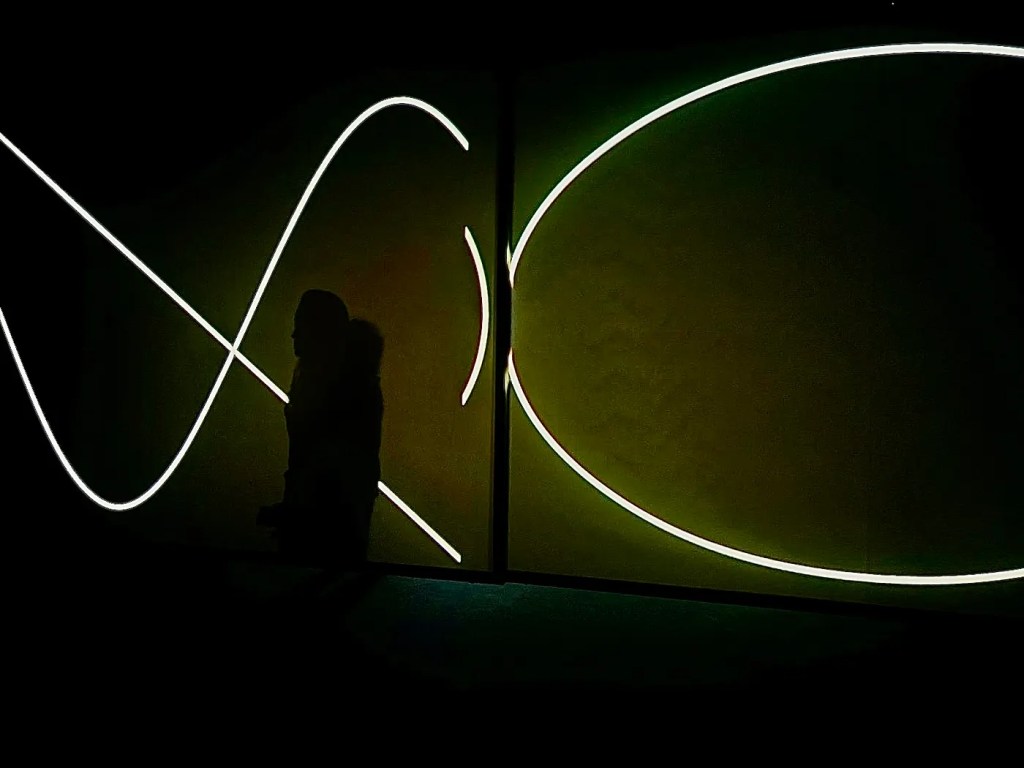
Inside the rooms, there is only darkness, mist, and projected light. Just beams cutting through space, forming slow, volumetric shapes.
I’m mesmerised.
The experience shifts your focus from what’s projected to where projection happens. You’re placed inside the machine’s head. You see at a distance — like someone sensitive trying not to be hurt.
What I like most is how the work refuses to let either light or darkness dominate. Both are necessary. Both carry weight. And in so doing, they remind us we have a choice.
The artist wants us to experience what it feels like to move towards the light. When I approach it, I feel like a kid — playful, curious.
When we reconnect with the child inside, we recover something pure. Not yet chipped. Not yet formatted.
A male visitor walks through the beam. For a moment, he splits into two shapes. A man with a shadow. A man with darkness. We all have something that isn’t crystal clear.
I step out.
A blonde in leather stands near the entrance, holding an old camera that makes loud, theatrical noises. She stares into nothing, eyes wide. An artist, maybe. Or someone performing interest.
It’s entertaining, guessing who comes here and why. Some people want to understand. Others collect the surface: the look, the language, the moral posture. They like what feels progressive without being inconvenient. They skim the message, skip the discomfort, avoid the dark side of the coin — the part about violence, exclusion, or their own reflection in it.
Inside, the artists spoke about exile, erasure, survival, about the worlds that crush outsiders. They didn’t tell us what to think. They left the door open. What we do after that is our problem.
I walk away, wet, unsettled, still thinking about the timid voice I almost missed and the girls in the photograph asking only to exist.
